
GrowGuide
Designing for low-literacy users in high-risk decision environments, benefiting 2,30,000 small and marginal farmers.
Project Overview
GrowGuide is a digital guidance system designed to help small-scale farmers navigate crop health monitoring and critical decision-making. Tasked with reaching 230,000+ farmers, the project involved a complete independent overhaul of a previous prototype to address major usability gaps for an audience with varying literacy levels and high dependency on agricultural outcomes.
My Role
UX Direction, User Flow Restructuring, Information Hierarchy, and High-Fidelity UI.
Design Approach
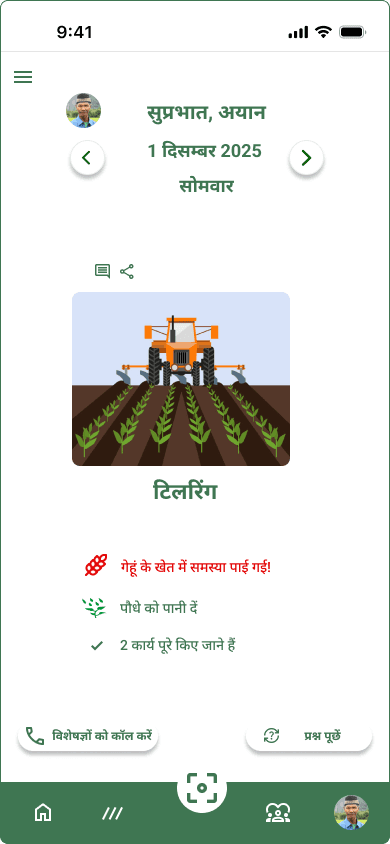
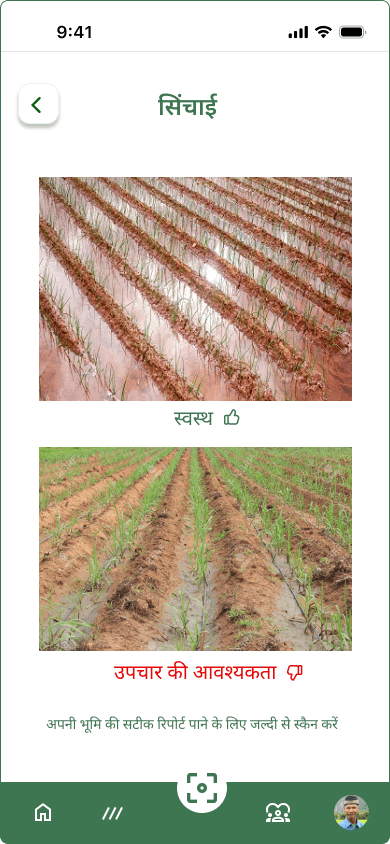
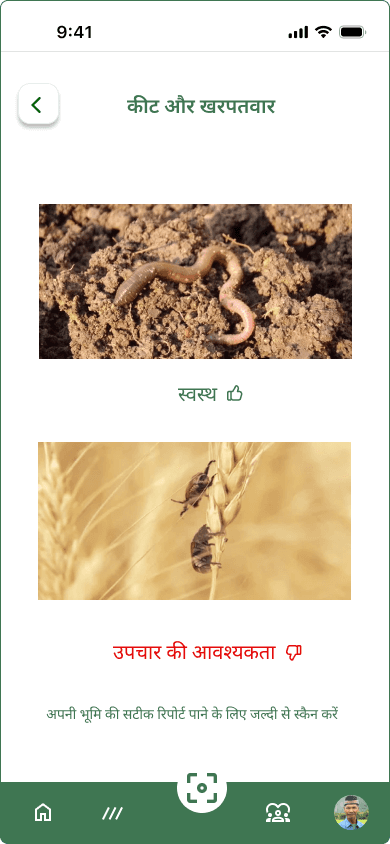
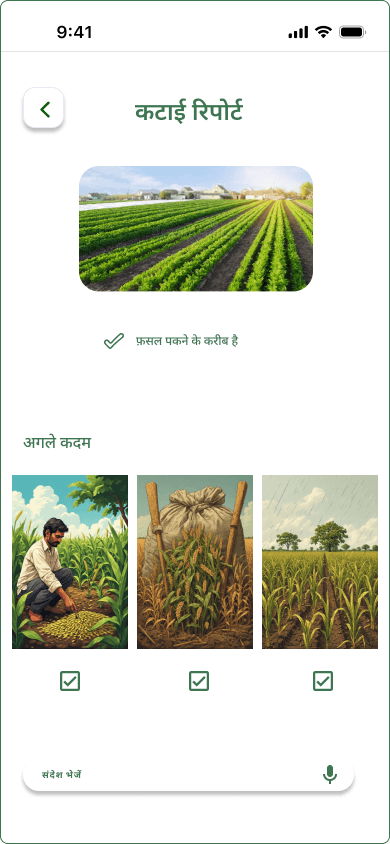
Visual-First Architecture: Replaced text-heavy instructions with crop health indicators and progress cues, shifting the interface from "reading-based" to "visual-recognition."
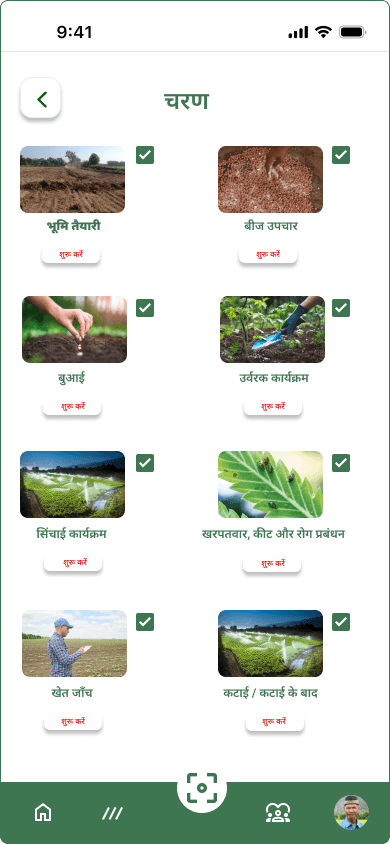
Linear Decision Pathways: Restructured the flow to follow a Guide → Suggest → Act logic, ensuring that the farmer is never overwhelmed by fragmented information.
Contextual Reassurance: Strategically placed feedback loops and "next-step" prompts to provide psychological reassurance to users dealing with high-stakes financial livelihoods.
Accessibility-Driven Simplification: Optimized the interface for low-bandwidth environments and limited tech fluency, intentionally omitting non-essential features to maintain maximum clarity.
Final Outcome
A streamlined, actionable solution that outperformed initial iterations in clarity and ease of use. Success was validated through farmer testing, where participants found the redesigned interface significantly more intuitive and safer to navigate, demonstrating how simplified design can directly empower and protect livelihoods in social-impact sectors.

Project Overview
GrowGuide is a digital guidance system designed to help small-scale farmers navigate crop health monitoring and critical decision-making. Tasked with reaching 230,000+ farmers, the project involved a complete independent overhaul of a previous prototype to address major usability gaps for an audience with varying literacy levels and high dependency on agricultural outcomes.
My Role
UX Direction, User Flow Restructuring, Information Hierarchy, and High-Fidelity UI.
Design Approach
Visual-First Architecture: Replaced text-heavy instructions with crop health indicators and progress cues, shifting the interface from "reading-based" to "visual-recognition."
Linear Decision Pathways: Restructured the flow to follow a Guide → Suggest → Act logic, ensuring that the farmer is never overwhelmed by fragmented information.
Contextual Reassurance: Strategically placed feedback loops and "next-step" prompts to provide psychological reassurance to users dealing with high-stakes financial livelihoods.
Accessibility-Driven Simplification: Optimized the interface for low-bandwidth environments and limited tech fluency, intentionally omitting non-essential features to maintain maximum clarity.
Final Outcome
A streamlined, actionable solution that outperformed initial iterations in clarity and ease of use. Success was validated through farmer testing, where participants found the redesigned interface significantly more intuitive and safer to navigate, demonstrating how simplified design can directly empower and protect livelihoods in social-impact sectors.